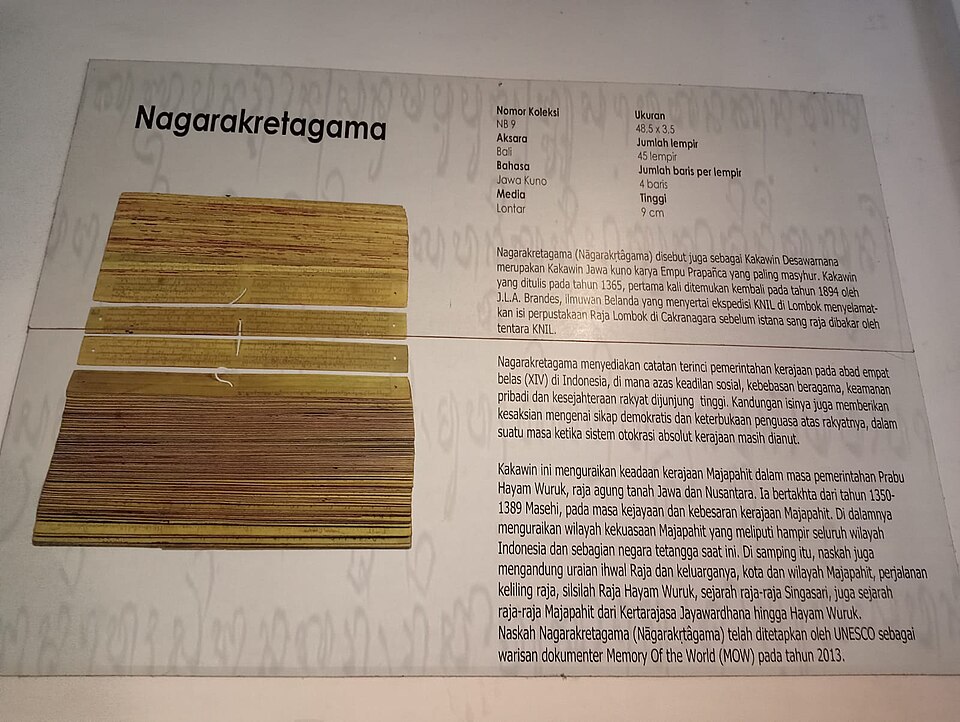
Object Name: Description of the Country
Object Type: Ancient palm-leaf manuscript, written in kakawin (Javanese poetic) form
Materials: Palm-leaf folios (ola leaves), inscribed with ink/stylus likely using organic or carbon-based black medium, bound with thread between perforations (traditional Javanese manuscript technique)
Dimensions: Specific dimensions vary by copy; typically each palm-leaf measures roughly 20–60 cm in length and about 4–5 cm in height depending on local format. Exact dimensions for the recognized manuscript at National Library Jakarta are not disclosed in public rec
Culture Origin: Majapahit Kingdom, Java (Indonesia); written by the court poet Mpu Prapanca ca. 1365 AD, during the reign of King Hayam Wuruk, covering Majapahit court life, toponymy, ceremonies, and rulership
Inscriptions: Contains Javanese-language kakawin text (metrical Sanskrit-influenced form). Many place-names, dates, and ceremonial descriptions are embedded; not epigraphic inscriptions on leaves but textual entries throughout the poem
Exhibition: Not typically exhibited in public display; held as a rare archival manuscript. Has been included in academic displays or facsimiles occasionally in Indonesia—but original is generally managed as part of library archives. UNESCO recognized the manuscript u
Condition: Well-preserved as archival heritage, given controlled climate storage. Typical aging of palm-leaf includes some brittleness, slight fading of ink, possible minor insect damage—but overall condition is good for a 14th-century manuscript. Detailed conservat
Conservation History: Originally part of VOC holdings in the Netherlands, returned to Indonesia in 1974 under repatriation efforts during Suharto’s government library and archives mission. Since then, conservation and documentation overseen by National Library of Indonesia, in
Preservation Status: Preserved as part of Indonesia’s Memory of the World collection; physical manuscript maintained under controlled conditions
Preservation History: Removed by Dutch from Lombok royal library in 1894; stored in Leiden until repatriated in 1970; recognized by UNESCO in 2008 and on International Register in 2013
Retention Policy: Permanent archival preservation
Archival Location: National Library of Indonesia, Jakarta
Backup Status: Digital surrogates maintained; UNESCO documentation and facsimiles archived in Memory of the World program
Parent Collection: National Library of Indonesia’s collection of ancient manuscripts
Sub Collections: Lontar Javanese kakawin manuscripts
Related Items: Other traditional Javanese kakawin manuscripts such as Sutasoma, Pararaton, Carita Parahyangan
Copyright Status: Public domain (over 600 years old)
Copyright Holder: None
License Terms: Governed by the National Library of Indonesia; available for scholarly use subject to archival access rules
Jurisdiction: Indonesia
Cultural Significance: The most detailed surviving literary account of the Majapahit Kingdom; instrumental in Indonesia’s national historical identity
Cultural Context: Written in praise of King Hayam Wuruk; collection of court rituals, cultural geography, and empire-wide influence during the 14th century
Access Statistics: Frequently referenced in academic and cultural heritage research; limited public display (solitary surviving copy)
Citation Information: Nagarakretagama Manuscript (Kakawin Nāgarakṛtāgama), Mpu Prapañca, 1365. National Library of Indonesia. UNESCO Memory of the World Register (Regional, Asia/Pacific), 2013.
User Feedback: Regarded as a national literary treasure; essential reference for Majapahit scholarship and Indonesian nationalist history
Educational Use: Used to study Javanese literature, Majapahit history, and premodern Southeast Asian political systems
Curriculum Alignment: Southeast Asian history, literature & culture, cultural heritage studies
Learning Objectives: Understand Majapahit governance, religious-historical narratives, and literary traditions of Old Javanese kakawin